
My fifth year thesis at Penn State was the crown jewel in my architectural education, this thesis morphed my passions for skiing, the outdoors, sustainability, design, research, and graphics into one. I studied fonts, layouts, drawing styles, and more to put together a complete story. You can find my full Thesis Book here or at the bottom of the page along with my Final Summary of my presentation given to jurors before the presentation. Immediately below is a short tour through my project.
Below: summary of project through images


***
THESIS STATEMENT:
To change the way users interact with the mountain and environment, a fundamental shift in the way people participate in mountain sports is necessary. At multiple sites on Snowmass Mountain, huts or complexes of huts will provide refuge, solitude, community, and reprieve to all types of users so as to reengage them with the landscape, their peers, and their sport. These interventions break the repetitive actions of mountain sport participants and help them discover the roots of their passion again.
Research:
The mountain sport industry suffers from an ‘elitist’ false persona where the common
person feels they have very limited access to participate. This is in fact false, as backed up by numerous surveys that suggests the number one reason why people don’t go to the
mountain is because they have no one to go with. The problem is clearly people connecting to people, or forgetting the reason why they participate in mountain sports: the thrill of experiencing such extreme terrain. See the first image below for data.
Studies of Olson Kundig’s shelters in the Pacific Northwest, many Chilean structures
scattered across the Andes, and resorts from Whistler and Vail to Chamonix have
provided valuable insight into the light-handed gestures of small architecture in extreme
environments, and the old and new ways of resort design. See the second image below for comparable resorts and their features.


Design:
The purpose of Project_Summit is to find a way to accentuate the beautiful mountain landscape through architecture and reinvigorate the mountain sport participants about the activities and environment in which they partake. Four modes of social connectivity
are made possible by the architectural interventions proposed on Snowmass Mountain:
connecting with oneself, one’s peers, the environment, and the larger community through an enhanced digital presence. These scales of work manifest architecturally through four typologies of huts: a digital pavilion (larger community), an observatory (environment), a sanctuary (oneself), and a concessions pavilion (one’s peers). Below are images of the geometric progressions of the pavilions and the material palette, followed by orthographics of each pavilion typology.


Mountain Siting:
Each typology of pavilion or hut caters to a specific program use. Each structure is placed on site according to a specific set of rules, and these sites are picked with yet another set of criteria. These guidelines along with material selection, and blending with the terrain
contribute to a much more harmonious balance with the environment than your typical
mountain lodge. They gingerly touch the ground using a non-invasive pin foundation
system. With all of these aspects in mind, it is feasible to look at Snowmass as a prototype
site for this architecture. There are 6 sites, and 2 huts per site, so each site has a unique
coupling of typologies. Below are examples of the site plans and area plans that were generated for each site. The next two images are maps of the entire mountain showing train overlap, seasonal relevance, and relative positioning on the mountain.


Modeling and Presentation:
I made a site model for each of the six locations. Three sites were modeled in winter, three in summer. I also made a five foot by five foot mountain model showing current buildings, trails, lifts, and proposed site locations. I wanted to avoid a problem of understanding the scale of the site for the jurors.


Imagery:
I created two panoramic vistas, the first image is of the Base Village installation, the second is of the Elk Camp pavilions. Under those are the renderings I made of the interiors of each pavilion typology. 1) Digital 2) Observatory 3) Sanctuary 4) Concessions.


Final Boards:
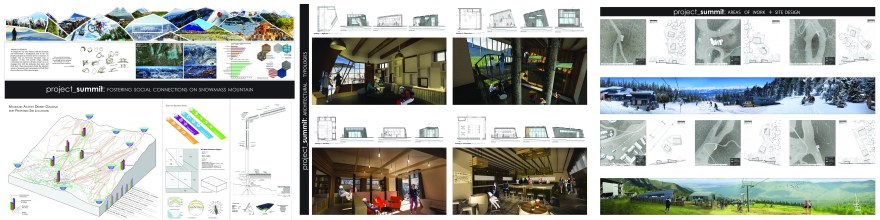
A visual representation of my final boards for my presentation.
Documentation:
Programs Used: Rhino, VRay, Sketchup, AutoCAD, Photoshop, Illustrator, GIS
 Scott Axel | Portfolio